
- Plumbing tools
- 10126 views
- 0 comments
Need to get started in some plumbing work? If you don't know where to start, Action-Bricolage presents the plumber's tools to install, prepare, cut, bend and unclog pipes.
Indispensable plumbing tools.
Whether you are an amateur or a seasoned plumber, to carry out plumbing work, it is essential to be well equipped: tube cutter, bending pliers, device to beat the collars, crimping pliers, pipe wrench , etc. Complete equipment is the guarantee of quality work! Action Bricolage presents today the essential tools of the plumber.
Tools for cutting pipes:
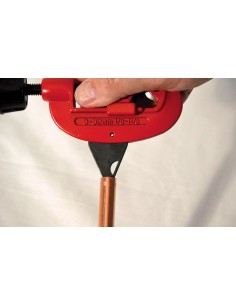
Pipe cutters are only for annealed copper pipes. For PVC and PER, special PER and multilayer pipe cutting pliers are used. If you don't have a specific pipe cutter or pliers, you can also use a hacksaw.
Pipe cutters:
There are different models of pipe cutters with dimensions from 0 to 42mm in diameter. For hard to reach places there are ratchet pipe cutters. The ratchet system requires only a small amount of travel (45 °). Some pipe cutters are equipped with a reamer that allows the pipes to be deburred.
The special PER and multilayer pipe cutters:
To make a cut on PER (polyethylene) and multilayer pipes, you must use a pipe cutter specially adapted for these materials. The PER and multilayer pipe cutter allows optimal use, without crushing the pipe. There are sizes from 0 to 50 mm in diameter.
Tools for bending tubes:
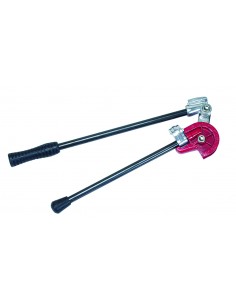
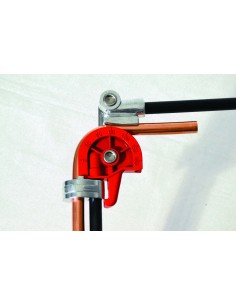
To bend pipes, the plumber uses different tools. First, the bending spring for annealed copper. Just insert the annealed copper tube inside the spring. Two rings on the ends allow you to apply pressure to bend the tube. The tool manufacturer PRCI has also patented its bending spring with sheathed rings in order to provide more comfort to its users. The bending spring for PER and multilayer: the principle is the same except that the spring is placed inside the tube. Springs cannot be used on the ends of a tube. For this, you must use a bending pliers. They allow the tubes to be bent up to 180 °. There are also crossbow type bending pliers. These have jaws of different sizes. The principle is to insert the copper tube between the jaw and the clamps, then to squeeze the handle to the desired angle.
The tools for connecting the tubes:
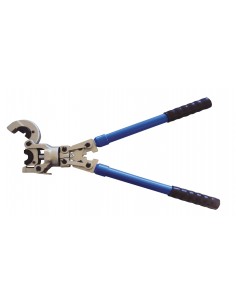
In order to connect the tubes, there are different tools. Snare beating devices are made up of two parts, a die and a flaring top. The matrix (10 to 22 mm) helps to hold the tubes. The router flares the tube in order to beat the collars. Some tops also allow beating the collars because they consist of two parts: top for flaring and mandrel for beating the collars. Universal socket devices allow the tubes to be adjusted for connection. The diameters range from 8 to 16 mm. The deburrers allow you to remove burrs after cutting the tube to obtain clean edges. The calibrators are used to modify the diameter of PER and multilayer pipes. Diameters can range from 16 to 32 mm.
Tools for screwing and tightening:
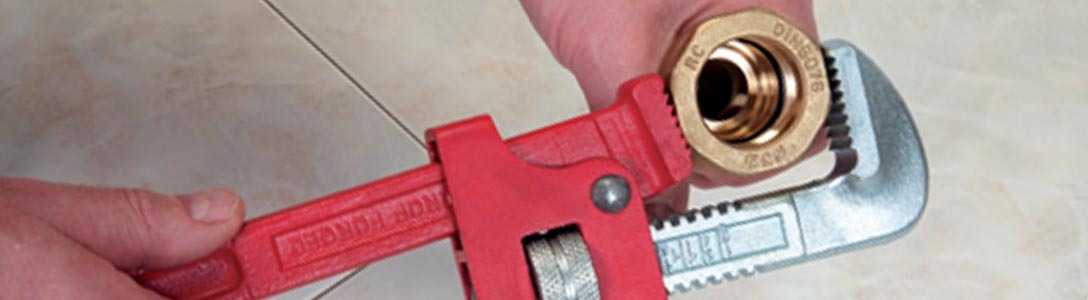
The sink wrench allows you to tighten and loosen sink nuts in hard-to-reach places thanks to its jaw that rotates 180 °. The stillson wrench or claw wrench is used to tighten and loosen copper tubing and nuts. It has a large adjustable clamping capacity thanks to its dial. The Swedish wrench or Swedish pipe wrench has the same functions as the stillson wrench. It is equipped with a ring which allows the jaw spacing to be adjusted to the desired diameter. The griptou pliers or multigrip pliers are used to tighten and loosen bungs and bolts of large diameters. Chain wrenches and strap wrenches are specially designed for tightening and loosening large diameter pipes and hoses. Regarding PVC, it is recommended to use a strap wrench to avoid damaging the tube.
Tools for welding:
The thermofusion device allows PER tubes to be welded by fusion at high temperature. Install the sockets corresponding to the desired diameter on the heating body. Once the temperature is reached, insert the PVC tubes on each of the sleeves. Then just connect the two tubes together.
Tools to unclog:
There are many tools available for unblocking pipes. The suction cup, a great classic, is widely used but not always effective. Here are the different models adapted to each situation.
The cane unblocker:
The cane unblocker is designed to unclog toilets. It consists of a rigid rod inside which is a hose with a ferret at its end. It is particularly easy to use. All you have to do is put the cane in the toilet, push in the hose until you feel resistance, then use the handle to rotate it.
The crank unblocker:
Another essential tool for unblocking all types of pipes: the crank unblocker. It consists of a hose, a crank and a ferret. There are several models depending on the length and diameter of the pipe to be unblocked.
The drum unblocker:
It consists of a plastic drum inside which is the coiled hose. It works with a crank and allows a cleaner use since the hose is stored directly in the drum during rewinding. You can choose the length of the hose according to the need thanks to a locking device.
The vacuum pump unblocker:
The vacuum pump unblocker consists of a piston. All you have to do is suck in air and send this pressurized air through the pipe to unclog it.
Find our range of plumbing tools on the plumbing tools page of our website www.action-bricolage.fr
Related products


Comments (0)